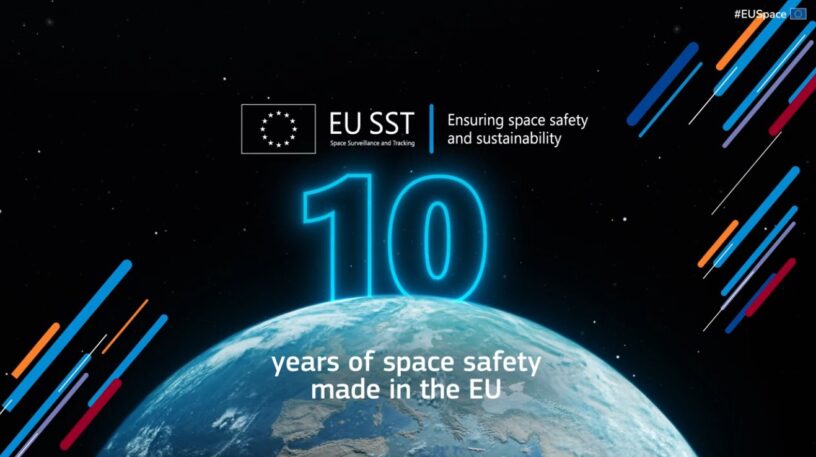
The European Union Space Surveillance and Tracking partnership, EU SST, marked ten years of operations in July 2026. Since its launch in 2016, EU SST has developed into a key European capability for improving the safety of space operations and supporting the sustainable use of the space environment. Finland contributes to this cooperation through the Finnish Space Situational Awareness Centre established at the Finnish Meteorological Institute.
The rapid growth of space activity is increasing the need to monitor satellites, space debris, and other objects orbiting Earth. As the number of objects in orbit rises, so does the likelihood of close approaches, collisions, fragmentation events, and uncontrolled atmospheric re-entries.
EU SST provides services that help satellite operators and public authorities identify and manage these risks. Its services include collision avoidance support, analysis of space objects re-entering Earth’s atmosphere, and monitoring of fragmentation events in orbit.
A European Network of 19 Member States
EU SST is based on cooperation between EU Member States. Over its first decade, the partnership has grown from a consortium of five countries into a network involving 19 EU Member States.
The European Union Agency for the Space Programme, EUSPA, acts as the central service desk for EU SST and supports the provision of services to users in Europe and worldwide.
EU SST relies on an extensive network of European sensors, including radars, telescopes, and other space surveillance and tracking systems. Observations from these systems are combined and analysed to produce an accurate and up-to-date picture of events in near-Earth space.
According to EU SST, the partnership’s main achievements during its first ten years include:
- Supporting more than 690 satellites in managing collision risks
- Providing services to more than 400 registered organisations
- Establishing a European network of more than 70 operational sensors
- Delivering collision avoidance and re-entry analysis services to users in Europe and internationally
These results demonstrate the growing importance of space situational awareness. Reliable information on the space environment helps protect satellites and space-based services on which modern societies increasingly depend, including telecommunications, navigation, positioning, timing, weather forecasting, and environmental monitoring.
Finland’s Role in EU SST
Finland joined EU SST in November 2022 as part of the development of its national space situational awareness capability. The Finnish Meteorological Institute, FMI, serves as Finland’s national point of contact for EU SST and is responsible for the civilian exchange of space situational awareness information with European and international partners.
Finland’s participation provides access to shared European observations, analysis services, and expertise. At the same time, Finland contributes its own national capabilities to the development of a common European space situational picture.
The cooperation strengthens Finland’s ability to identify risks affecting satellites and other critical space-based services. It also supports the safety of governmental, scientific, and commercial space activities.
The Finnish Space Situational Awareness Centre at FMI
The Finnish Space Situational Awareness Centre, known as AVATIKE, has been established at the Finnish Meteorological Institute. Its Civilian Operations Centre is responsible for producing, maintaining, managing, and distributing Finland’s national space situational picture in cooperation with the centre’s military component.
The Civilian Operations Centre provides space situational information and related analyses to government agencies and public authorities. When necessary, information can also be distributed to critical infrastructure operators and other national stakeholders.
Its responsibilities include:
- Producing and maintaining an up-to-date national space situational picture
- Distributing relevant information to Finnish authorities and other users
- Coordinating the use of national observation systems that contribute to space situational awareness
- Issuing information and warnings about potential hazards or disruptions arising from space or space activities
- Acting as Finland’s national EU SST contact point for civilian information exchange and cooperation
- Developing the service, data-transfer, and information-sharing solutions required for national operations
In the future, the AVATIKE will also centrally monitor satellite systems that are critical to the functioning of Finnish society. If disruptions or significant deviations in service levels are detected, the centre will be able to provide warnings to relevant national stakeholders.
This capability will strengthen national preparedness and improve Finland’s ability to respond to incidents that may affect critical satellite-based services.
As Finland’s national EU SST contact point, the AVATIKE receives European space situational awareness information and distributes it to relevant national users. The centre’s services and data-transfer solutions have been designed so that public-sector users can access the information without having to make separate investments in technical infrastructure.
National Observations Support the European Capability
The National Land Survey of Finland supports the production of Finland’s national space situational picture through its near-Earth space observation systems.
The National Land Survey operates the Metsähovi Geodetic Research Station, where part of the capacity of the satellite laser-ranging telescope is allocated to observations required by the Finnish Space Situational Awareness Centre. Satellite laser ranging enables highly accurate measurements of the distances to satellites equipped with suitable reflectors.
In the future, Metsähovi is expected to support the centre with an increasingly capable laser system. The National Land Survey is responsible for managing and operating the laser telescope systems at the research station.
Cooperation between FMI, the National Land Survey, other national authorities, and European partners connects Finland’s observation and analysis capabilities to the wider EU SST network.
Opportunities for Finnish Organisations
Participation in EU SST also creates new opportunities for Finnish companies, research institutes, and other organisations to contribute to the development of European space surveillance and tracking capabilities.
EU SST regularly launches procurement procedures and development projects in areas such as sensor technologies, data processing, software, analysis methods, and service development. Finnish organisations can provide relevant expertise and technological solutions through these activities.
The cooperation therefore supports not only national security and preparedness but also the development of Finnish space-sector expertise and business activities.
Anniversary Event in Brussels
The first decade of EU SST operations will be celebrated at the EU Space Surveillance and Tracking 10 Years Operations Anniversary Event in Brussels on 21 October 2026.
The event will bring together European space organisations, public authorities, researchers, companies, and other stakeholders to review the achievements of EU SST and discuss the future of space safety and sustainability in Europe.
Looking Ahead
The role of space surveillance and tracking is expected to become increasingly important as orbital activity grows and the space environment becomes more complex.
EU SST aims to further strengthen Europe’s capacity to monitor the space environment, protect satellites, and support safe and sustainable space operations. The partnership will also contribute to the development of European Space Traffic Management capabilities.
For Finland, participation in EU SST and the establishment of the Finnish Space Situational Awareness Centre represent important steps towards a coordinated national capability. By combining European information and services with national observations and expertise, Finland can better protect critical space-based services and contribute to the safety and long-term sustainability of space activities.
Sources
- EU SST, EU SST Marks 10 Years Ensuring Space Safety and Sustainability