
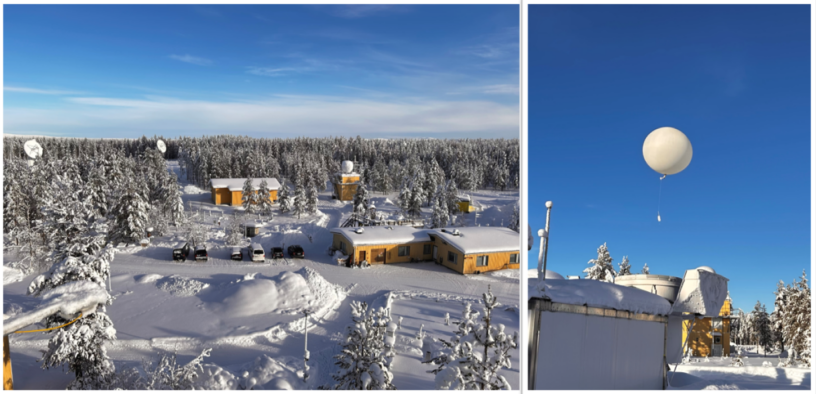

With the NASA Artemis II mission crew safely back on Earth, scientists at FMI can look back to their somewhat serendipitous involvement in mission preparations and instrument development. Stratospheric balloon flights at the Sodankylä Arctic Space Centre helped to test an engineering model of an instrument built by the German Aerospace Center DLR for the NASA Artemis II mission.
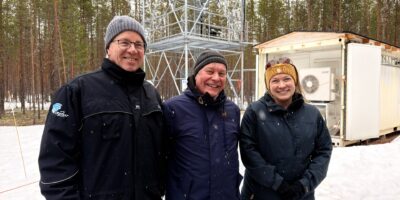
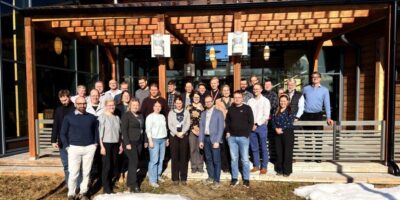
The U.S. National Science Foundation (US-NSF) funded Sodankylä balloon project was led by Prof. Lauren Blum (University of Colorado; USA), Dr. Mick Denton (Space Science Institute, Boulder, Colorado, USA), Dr. Rigel Kivi (Finnish Meteorological Institute), and Prof. Pekka Verronen (Finnish Meteorological Institute and Sodankylä Geophysical Observatory of the Oulu University).
In March 2023, a series of stratospheric balloon flights were launched from Sodankylä as part of the US-NSF project to study the effects of high energy particles on stratospheric ozone chemistry. With some payload space available, the project was open for “guest instruments” to fly on the same balloon flights, to maximize the science return from the flights. One guest instrument launched from Sodankylä was the engineering-model of the M-42 EXT instrument, built by the colleagues from the Institute of Aerospace Medicine of the German Aerospace Center DLR. The M-42 EXT sensor was designed to monitor the radiation exposure within the Orion crew capsule. There were four flight-model M-42 EXT instruments onboard the Artemis II mission.
In Sodankylä, with each balloon launch, the payloads ascended to around 30-35 km altitude, recording data throughout the flight, including during a parachute-assisted descent to Earth. Valuable diagnostic data from each flight were returned to the team at DLR.
Dr. Denton was looking back on the project: “I recall we flew the M-42 EXT instrument three times from Sodankylä and safely retrieved it each time. It is quite satisfying today, with Artemis II safely returned from the Moon, to have contributed something to the mission, even in quite a limited way”.
Dr. Kivi stated: “FMI has long-term experience with balloon borne measurements. At Sodankylä more than 58 000 balloon launches have been performed since the station was established in Sodankylä in 1949. Since September 2025 activities at Sodankylä are supported by the ESA–FMI Arctic-Boreal Earth Science, Calibration and Validation Supersite project”.
More information
Earlier news published: Stratospheric balloon campaign at the Arctic Space Centre in Sodankylä
DLR’s press release: https://www.dlr.de/en/latest/news/2026/artemis-ii-launches-to-the-moon-with-german-and-european-tech-on-board
Dr. Rigel Kivi, Senior Research Scientist, Finnish Meteorological Institute, rigel.kivi@fmi.fi
Prof. Pekka Verronen, Finnish Meteorological Institute and University of Oulu, pekka.verronen@fmi.fi
Prof. Lauren Blum, University of Colorado, Boulder, USA
Dr. Michael H. Denton, formerly at Space Science Institute, Boulder, Colorado, USA
Dr. Thomas Berger, Head of Radiation Biology Department, Institute of Aerospace Medicine, DLR


Leave a Reply
You must be logged in to post a comment.